

Trinity RFPG seeks data for flood planning
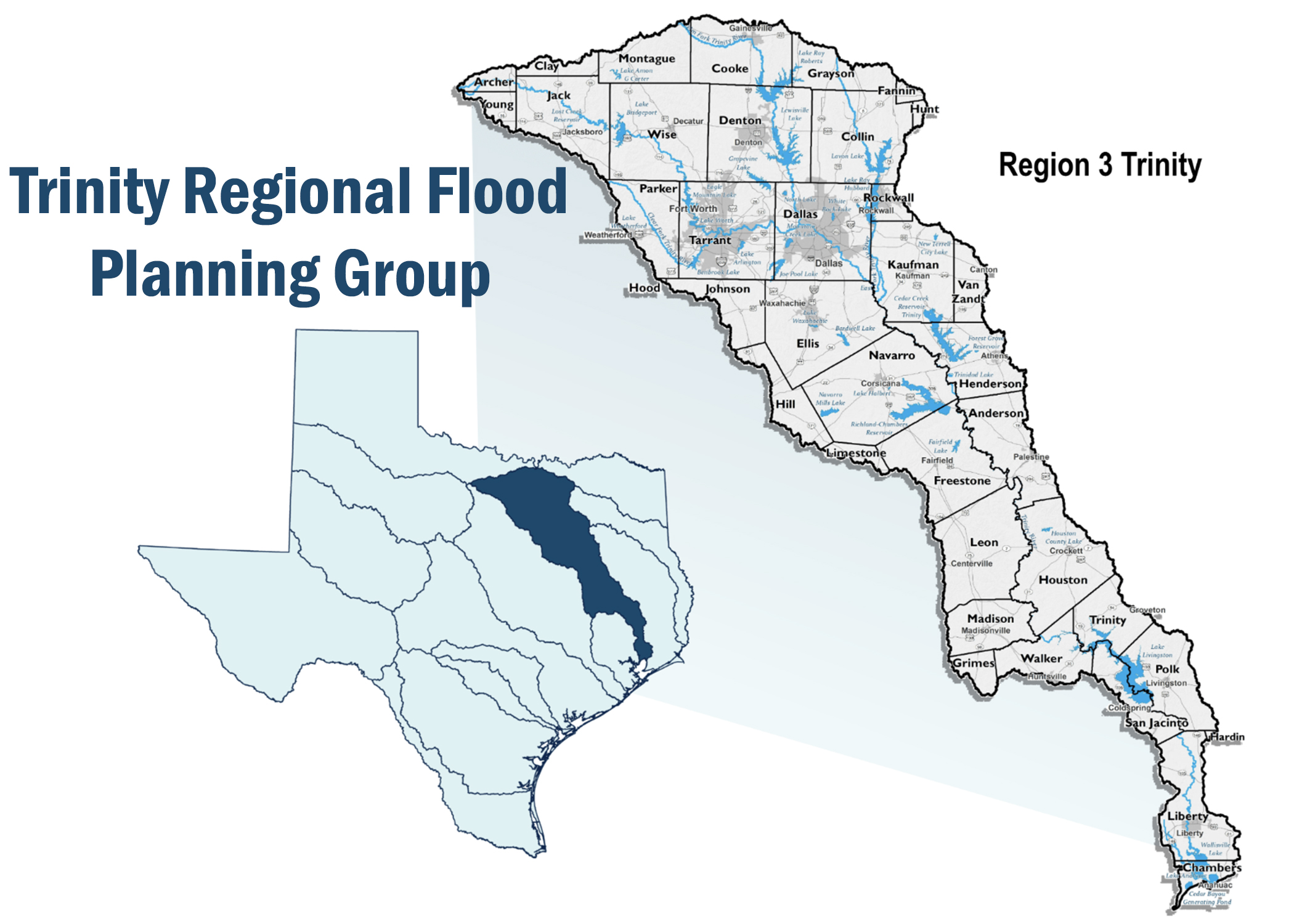
The Trinity Regional Flood Planning Group seeks information from the public to help develop the 2028 Trinity Regional Flood plan Data can be submitted through the online survey and interactive web map at https://trinity.halff.com/.
Glenn Clingenpeel, chairman of the Trinity RFPG, said the extension gives more residents an opportunity to participate in the planning process.
“If we don’t get the information from the individuals, from the local communities affected, it’s very hard for us to know what’s going on in those areas,” Clingenpeel said. “So not only what is an individual experiencing in terms of flooding, where are our roadways being overtop during flood events, but also what is your municipality doing about it.”
The planning process follows significant flooding events across Texas between 2015 and 2019, which came after a five-year drought.
“We had five years of drought juxtaposed with five years of significant flooding. And I think that really made an impression on a lot of people,” Clingenpeel said.
The drought occurred from 2011 to 2014, followed by record-setting floods from 2015 through 2019. During that period, Texas experienced Hurricane Harvey in 2017 and Tropical Storm Imelda in 2018-2019, which affected the lower parts of the Trinity Basin.
The Texas Legislature created the regional flood planning process in 2019, following the model of the state’s water supply planning. The state is divided into 16 planning regions, with the Trinity Basin covering nearly 18,000 square miles across 38 counties from Cooke County in the north to Chambers County on the Gulf Coast.
“The Texas legislature took the success of that water planning and said, let’s do the same thing for flood planning,” Clingenpeel said. “They applied that same general framework to the flood planning process and created this flood planning process and enabled the Texas Water Development Board to stand this whole process up.”
The Trinity RFPG held its inaugural meeting in October 2020, during the COVID-19 pandemic. The group had just 18 months to develop the first flood plan for submission to the Texas Water Development Board.
Public participation is crucial for developing effective flood solutions. When residents and local entities submit information about flood-prone areas, the planning group can better identify risks and potential solutions.
“It’s hard for us to understand what’s going on at that local level. And so in a nutshell, I think that’s why it’s so important for that information to be given to us through this data collection tool,” Clingenpeel said.
Clingenpeel emphasized the “bottoms up” approach of the planning process.
“I think that’s one of the things that has been so successful about the water planning process is that it’s not a group of bureaucrats in an ivory tower in Austin looking out and saying, well, you need this and you need that. It’s asking the people that are being affected by this that have the needs,” Clingenpeel said. “I think it’s a very Texan way to go about things.”
The first-ever Trinity Regional Flood Plan, adopted in 2023 and now part of the 2024 State Flood Plan, includes 56 recommended Flood Mitigation Projects (FMPs), 507 recommended Flood Management Evaluations (FMEs) and 138 recommended Flood Management Strategies (FMSs).
The 2023 Trinity Regional Flood Plan draws on science, data, models and flood risk mapping to recommend over $1 billion in flood mitigation actions to fix local flooding issues and reduce flood-related loss of lives, property and livelihoods.
Projects included in the final plan become eligible for funding through the Flood Infrastructure Fund, which was approved by Texas voters in 2019. This funding is only available to projects included in the state flood plan.
“In order to be eligible to apply for FIF funding, you must be in the state plan,” Clingenpeel said.
Clingenpeel said communities that don’t participate miss an opportunity.
“What happens is if you’re not in the plan, then you’re not eligible for the flood infrastructure funds, the grant money that the legislature has specifically earmarked and set aside for flood risk reduction activities,” Clingenpeel said.
The planning group considers three types of flood risk reduction activities: flood management evaluations (studies), flood mitigation projects (physical infrastructure), and flood management strategies (warning systems or public outreach).
“FME is a study, a project is a physical project. So you’re turning dirt, you’re pouring concrete, you’re actually doing something that is modifying the hydraulics or the hydrology of a particular area,” Clingenpeel said. “The FMS can be very important too. These can be strategies like gates at low water crossings. This can be public outreach, right? So some kind of public notification system, a reverse 911, for instance, anything that alerts the public to impending flooding.”
Efforts are made to ensure rural and underserved communities have their voices heard in the planning process.
“It’s well understood, and it was very evident in the legislation that created the flood planning process, that this was intended to help out those communities,” Clingenpeel said. “It wasn’t supposed to be a mechanism to fund one group or another. There needed to be a concerted effort to get these resources into the rural communities that may not have the tax base or the other resources to tackle some of these problems.”
The Trinity RFPG holds meetings throughout the region and offers virtual participation options. The group recently met in Huntsville and has previously held open houses in Liberty, Crockett and Fort Worth to engage directly with residents.
Clingenpeel described how the group was able to help residents who attended an open house in Fort Worth the day after a significant flooding event in August 2022.
“Wehadpeoplewho came to that open house, who had just been flooded. Their house had been flooded. And they were saying, well, what’s the plan? And we were actually able to say, here’s your neighborhood, here’s why it flooded,” Clingenpeel said. “And here’s the plan that’s on the books to help these individuals.”
The Trinity River Authority previously received $1.17 million in flood infrastructure funding to study flooding along the Middle Trinity. The study examined various flood reduction strategies for the area, which experienced significant flooding in 20152016.
“The Trinity River Authority undertook this flood infrastructure funded study on the mid-Trinity to look at different flood risk reduction activities that might be effective in that region. And what we found is that the most effective would be a flood management strategy that involves a flood warning system,” Clingenpeel said.
Clingenpeel emphasized that the regional flood planning process focuses on mid and long-term planning rather than immediate flood response, which is handled by existing emergency management agencies.
“What the Regional Flood Planning Group does is planning. And so we’re not in the business of immediate flood response or near-term flood response,” Clingenpeel said. “This is more of a longer term planning. And I think that’s part of a bigger solution.”
When visiting the data collection website, representatives from cities and other entities must register by providing an email and creating a password. Once logged in, users will answer no more than 25 questions related to flood history, storm drainage systems and critical infrastructure.
Members of the general public are also encouraged to participate and share their knowledge of floodprone areas. To access the public input map, users need to provide their name, physical address and email address. The RFPG will use contact information only to confirm unusual or extreme responses.
Residents who have experienced flooding are asked to visit the planning group’s website and complete the survey. They can also submit comments through the website or by email at info@trinityrfpg. org.
“That’s actually a data point on a map that we can use to understand where people are actually experiencing flooding,” Clingenpeel said. “We welcome that public input. It’s data, it’s information that helps us do our jobs better.”
For those wishing to share relevant documents, data, or who have additional questions about the data collection process, Project Manager Stephanie Griffin with Halff Associates, Inc. can be contacted at 817-8135704 or sgriffin@halff.com.
For more information or to subscribe to receive future updates, visit the website at Trinityrfpg.org.
